I grew up in inner city Baltimore during the mid-90s, when glass hair "ballies," sectioned ponytails, and "jelly" sandals reigned supreme. I remember one of the first times I really noticed those plastic, transparent shoes on the feet of one of the most popular girls in my class: she'd paired them (or her mother had) with the cutest jean jackets and sunflower print dresses. And of course, those jelly sandals matched every effin' outfit.
One summer afternoon while my mom and I were in Sears, I asked her to buy me a pair, but she was all, "you'll step on [drug] needles wearing those." And so I had to resign myself to voyeurism, looking on as my friends played tag in their jellies--they even had the ones with glitter inside the straps! Life wasn't fair :-/
Jellies went out of style for awhile after elementary school (at least, for people my age). When I entered middle school, in fact, bragging about one's "butters" [Timbaland boots] became the norm. I guess we all had kind of outgrown those fragile shoes, wanting more durable ones to establish some sense of status in our little social spheres, perhaps.
Just when the memory of jelly sandals was fading from my mind, I saw a yellow pair dangling from a shelf in Aeropostale, the other day. Then I spotted some green ones in Aldo. (It was then that I wanted to give the merchandisers the highest of fives for bringing these shoes back in style). Instead of the squishy soles of our youth, plastic sandals are now reinforced with hard bottoms--totally upcycled if you ask me.
And so, the love story between me and these sandals is nearing its culmination; I plan to wear them on a sun-bleached sidewalk somewhere in the middle of a city summer :-)
Monday, May 14, 2012


Monday, May 7, 2012
Top Wardrobes in Film
I have a recurring fantasy in which I enter a room at a party and stun everyone with my beauty-- you know, like the heroines do in the movies.
Moments like these are celebrated in fashion magazines all over the world; however, there's something to be said for unexpected looks--the styles that may not smolder off the screen and find their way into our literature, but which still manage to leave an impression anyway.
Here are my (not-quite-so-obvious) favorite styles in film:

A coronet of hair paired with a menswear suit? Check! A tomato colored scarf draped over the greenest of dresses? You got it. In this fascinating biopic, Frida Kahlo (played by Salma Hayek) wears whatever she wants and it all looks great. Sure, her wardrobe doesn't always make sense to the eye, but its refreshing blend of influences--- folkish, modern, and somewhat masculine, give the film a surreal feeling. And just look at that bundle of flowers growing from her hair. You wish you had fresh blooms lying around to tuck in yours (well, I do).

Long before there were any black swans, there lived the innocent Simonetta (played by Loretta Young). In this silent classic, she traipses about in tulle and satin, courted by her, er, adopted dad, Lon Chaney. Throughout the film, her hair is appropriately poufy and her eyeshadow, smeared in the flapper style. Running away with the circus never looked so appealing.


Don't even lie to yourself: Meryl Streep is a pure BAMF here, perpetual somber face and all. Take a quick gander at those frizzy, Pre-Raphaelite curls in the trailer below. And then envy her 1980s razor bob as the scenes alternate between centuries.

Back in the 1990s, I aspired to look like Janet Jackson, mid-back length braids, belly shirt, and all. Even now in 2012, I imagine my best-looking self with long ropes of hair. The Poetic Justice style remains popular (re Solange), because braids are timeless. They might change in thickness or length, but are always chic.

Deborah Kerr is utterly first-world in every frame of An Affair to Remember. Because of this, I couldn't muster up much sympathy for her, while watching. Maybe I would have if she didn't own such an awesome fur stole.

Kate Hepburn wore menswear before Diane Keaton made it popular in the 1970s (and I guess Marlene Dietrich made it popular before anyone, but that's beside the point). In Bringing up Baby, Hepburn's smart, tailored dresses offer a glimpse of the things to come for women-- mainly shoulder pads, neckties, and a certain androgynous swagger.


And so, I end my short list with a deliciously hipster film. In the 500 Days of Summer, Zoey Deschanel is a modern muse, wearing a mix of trends from the last few decades. She exudes a devil-may-care attitude, manifest in strappy summer dresses, faux pearls, and distressed short-shorts. Of course I love her for it.
Some honorable mentions:
Undercurrent (1946)
The Little Mermaid (1989)
Vertigo (1958)
La Dolce Vita (1960)
Daughters of the Dust (1991)
All images provided via google.
Moments like these are celebrated in fashion magazines all over the world; however, there's something to be said for unexpected looks--the styles that may not smolder off the screen and find their way into our literature, but which still manage to leave an impression anyway.
Here are my (not-quite-so-obvious) favorite styles in film:
Frida (2002)

A coronet of hair paired with a menswear suit? Check! A tomato colored scarf draped over the greenest of dresses? You got it. In this fascinating biopic, Frida Kahlo (played by Salma Hayek) wears whatever she wants and it all looks great. Sure, her wardrobe doesn't always make sense to the eye, but its refreshing blend of influences--- folkish, modern, and somewhat masculine, give the film a surreal feeling. And just look at that bundle of flowers growing from her hair. You wish you had fresh blooms lying around to tuck in yours (well, I do).
Laugh, Clown, Laugh (1928)

Long before there were any black swans, there lived the innocent Simonetta (played by Loretta Young). In this silent classic, she traipses about in tulle and satin, courted by her, er, adopted dad, Lon Chaney. Throughout the film, her hair is appropriately poufy and her eyeshadow, smeared in the flapper style. Running away with the circus never looked so appealing.
Sabrina (1954)

Audrey Hepburn's classically gamine style is no more stunning than in this mid-20th century film. Here, we witness her evolution from mere ponytail wearer to Paris-educated sylph. Admittedly, Hepburn is equally stylish in Roman Holiday, but Sabrina's aesthetic seems less forced.
The French Lieutenant's Woman (1981)

Don't even lie to yourself: Meryl Streep is a pure BAMF here, perpetual somber face and all. Take a quick gander at those frizzy, Pre-Raphaelite curls in the trailer below. And then envy her 1980s razor bob as the scenes alternate between centuries.
Poetic Justice (1993)

Back in the 1990s, I aspired to look like Janet Jackson, mid-back length braids, belly shirt, and all. Even now in 2012, I imagine my best-looking self with long ropes of hair. The Poetic Justice style remains popular (re Solange), because braids are timeless. They might change in thickness or length, but are always chic.
An Affair to Remember (1957)

Deborah Kerr is utterly first-world in every frame of An Affair to Remember. Because of this, I couldn't muster up much sympathy for her, while watching. Maybe I would have if she didn't own such an awesome fur stole.
The Philadelphia Story (1940)

Kate Hepburn wore menswear before Diane Keaton made it popular in the 1970s (and I guess Marlene Dietrich made it popular before anyone, but that's beside the point). In Bringing up Baby, Hepburn's smart, tailored dresses offer a glimpse of the things to come for women-- mainly shoulder pads, neckties, and a certain androgynous swagger.
An American in Paris (1951)

The 1950s was famous for its high fashion musicals (re Funny Face). I may or may not prefer this one because of Gene Kelly's overall
attractiveness over Fred Astaire's. Really though, it's because the clothes are buoyant and fun, much like the (highly improbable) plot.
The 500 Days of Summer (2009)

And so, I end my short list with a deliciously hipster film. In the 500 Days of Summer, Zoey Deschanel is a modern muse, wearing a mix of trends from the last few decades. She exudes a devil-may-care attitude, manifest in strappy summer dresses, faux pearls, and distressed short-shorts. Of course I love her for it.
Some honorable mentions:
Undercurrent (1946)
The Little Mermaid (1989)
Vertigo (1958)
La Dolce Vita (1960)
Daughters of the Dust (1991)
All images provided via google.
Monday, April 2, 2012
Jenny Packham

(via)

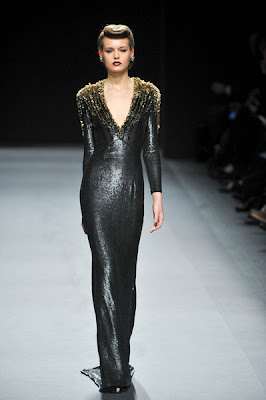
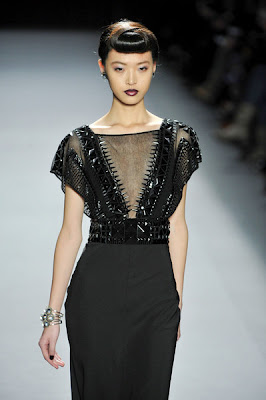
Jenny Packham’s 2012 designs range from tangy, orange dresses to taupe jumpsuits. Some have criticized her aesthetic for being too sweet. To me, her collections simply have an energetic point of view--one that alternates between feminine indulgence and restraint.
Her spring collection, full of breezy fabrics, celebrates womanhood—and that flute of bone that looks good on every body type. Here, the materials flow in universally appealing shapes.
(via)
In her fall collection, she does not abandon these fabrics, but restrains their silhouettes. Worn on lip-lined, pompadour-ed models, her fall clothes have a severe subtext. They are still sweet, yet also powerful, with a distinct wartime sensibility. Through both collections, Packham touches upon a multitude of fashion influences--including 1940s noir, Victorian Gothicism, and Lisa Frank.
(via)
Packham’s aesthetic touches my heart.
As Sarah Joynt writes, her fall collection is a “story of shoulders.”
Certainly, shoulders never looked so good.
Tuesday, March 27, 2012
My Favorite Color


Don't pretend like gray isn't your favorite color. And if it isn't, it should be.
I wasn't always wise enough to appreciate the many shades of gray--cream pearlescence, metallic silver, charcoal, granite....
Over the years, in fact, I've experimented with colors on all sides of the wheel. In elementary school, I dressed my Kellys in dark purple because pink was too mainstream. Then I adored teal for awhile, because, what soulless person doesn't like teal? Somewhere in there, I swore my love to marigold.
Anyway, after many years of soul searching and contemplation, I decided, one day, that my favorite color was gray. And so far, no hue has surpassed it yet--not okra, turquoise, or even navy blue.
Because whenever I wear slim, gray jeans, or a slate gray dress, I feel like a cloud.
Or a statue.
Or a foggy morning ;-)
In gray, I'm a shapeshifter---versatile, modest, and even quietly stunning on occasion.

InStyle Magazine, April 2012.
As we've seen from this year's runway and award shows, white, black, and red are en vogue, as they usually are and should be.
But let's not overlook the beauty of a light gray dress.


Tuesday, March 6, 2012
Cool: 2005
Gwen Stefani - Cool from morimoto shintaro on Vimeo.
When it comes to music videos, this one is my favorite of all time. The mix of high and low fashion and the eclectic prints provoke a sense of nostalgia in me for some reason. It's disorienting. And I love that I can't locate the time period that the flashbacks take place in. They just exist somewhere in the ideal past, in the old world.
What's your favorite, stylish video?
Tuesday, February 28, 2012
3 Reasons You Should Love Rooney Mara's Dress

Alright, I confess: I haven't watched the American version of the Girl With the Dragon Tattoo. And I may or may not have even known who Rooney Mara was before Oscar night. But now, after seeing her on Sunday, I've decided to hop on the Rooney bandwagon...and will be riding it until the wheels fall off.
So here are 3 reasons you should love her Oscar 2012 look.
1. Choice of color: White was the hue of the night, seen in two stylish extremes: lavish detailing (Milla Jovovich, BingBing Li) and restrained draping (Gwyneth Paltrow). Rooney's floor-length dress straddled the middle ground, shying away from expected silhouettes. Not only did the look pay homage to the film of the night, The Artist, but it went beyond 1920s flapper and into art deco territory. I'm not sure the dress would have been as striking or as classic in another color.
2. Minimal styling: To me, the ensemble had the elements of an old Hollywood look--punch red lips and high fashion hair (which was exquisitely severe in this case :-).
3. Design: The transparency of the dress (which revealed its structure when Mara turned her back to the cameras) modernized the look. I really loved the little lines of symmetry across her skin.
((In other news, Berenice Bejo's hair looked fantastic, n'est-ce pas?))

Saturday, January 7, 2012
Blackness
What a great thing it is to be young, gifted, and black!


Concurrently, the borders of race are continuing to blur and along with them, formerly distinct aspects of American culture. More aware of race as a social construction, some young Americans are rejecting prescribed roles (that to be black is to behave like x, and to be white is to behave like y) and instead, are asserting who they are and what they like by embracing eclectic interests (untethering these interests from the categories of race and class).
Now, fashionistas like Solange and Janelle Monae create pop art within a boundless context enriched by blackness---and it's anything but monolithic. As they've shown us, blackness is performative and almost always, beautiful.
Janelle Monae serves us androgyny:

Marie Claire 2011
Rihanna, the gamine:

Italian Vogue 2009
The earthy Esperanza Spalding:

These ladies demonstrate how limitless cultural identity can be.
Of course, such an increase in popularity is not without its drawbacks. I hope that one day, we will be as mainstream in the fashion world as we are in music, not treated as topical themes but as eternal muses.
Over the past few years, natural hair and prints inspired by the vast continent have been widely embraced in America. Afros, bantu knots, and curls are literally blossoming from the heads around us. Instead of mere attitude, we now carry something like...negritude.
Concurrently, the borders of race are continuing to blur and along with them, formerly distinct aspects of American culture. More aware of race as a social construction, some young Americans are rejecting prescribed roles (that to be black is to behave like x, and to be white is to behave like y) and instead, are asserting who they are and what they like by embracing eclectic interests (untethering these interests from the categories of race and class).
Now, fashionistas like Solange and Janelle Monae create pop art within a boundless context enriched by blackness---and it's anything but monolithic. As they've shown us, blackness is performative and almost always, beautiful.
Janelle Monae serves us androgyny:
Marie Claire 2011
Rihanna, the gamine:
Italian Vogue 2009
The earthy Esperanza Spalding:
These ladies demonstrate how limitless cultural identity can be.
Of course, such an increase in popularity is not without its drawbacks. I hope that one day, we will be as mainstream in the fashion world as we are in music, not treated as topical themes but as eternal muses.
Subscribe to:
Posts (Atom)